What Investors Really Want to See in Your MVP
You have an idea, you’ve worked hard on it, and now you’ve finally got the MVP ready to show the investors.
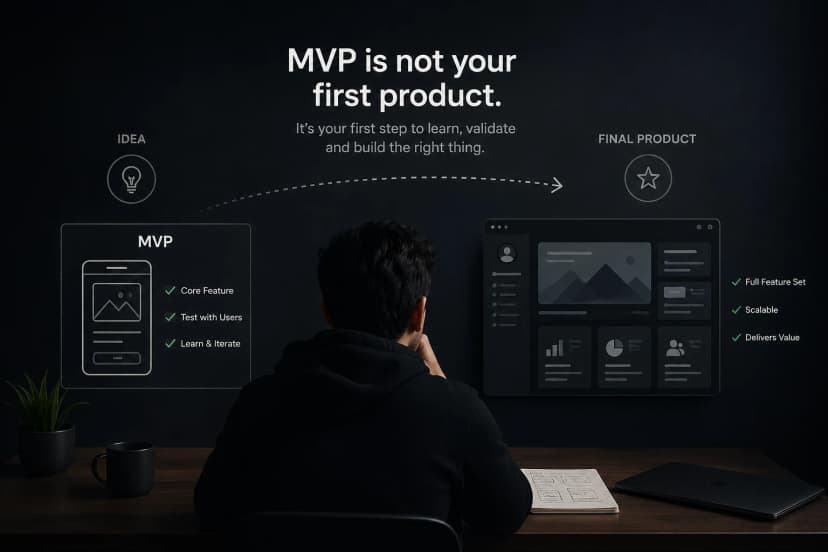
Some founders treat MVP like a stripped-down version of their future product. For some it’s problem validation in MVP stage. And some strive to get it as close to the final product as possible.
But the truth is, investors are not evaluating how close you are to the final version. They are actually reading between the lines. They are checking whether you understand the problem deeply enough to build something that is focused? Do you know what to leave out? And most importantly, why does this need to exist now?
In short, they are evaluating you and your thinking.
What your MVP says without saying it
An MVP quietly reveals more than you think. It tells the investor how you look at a problem, define it, and make decisions while balancing your ambition.
So, if the MVP is cluttered, it often signals confused thoughts, but if it’s a sharp one, it suggests clarity. Even the smallest choices, from features to user flow, reflect your judgment.
In short, an MVP reveals all the important behind the scenes to an investor.

What investors look for in MVP
- Evidence of real problem validation in MVP
The basic question that the MVP should answer is, does this solve a real problem in a meaningful way?
Investors want evidence that the problem is not imaginary and that you’ve picked a clear, specific pain point to solve based on research and data of a substantial kind.
This is where validation comes into the picture. This can be shown through user interviews, real testimonials, industry research and data that point out where users have a particular pain point. Even the little hacks people already use to work around the problem send a strong signal that the problem is real.
A strong example is Amazon. It started with only books in the beginning, as they were easy to catalogue and ship. Their goal was to test if people would buy things online. Once they validated people trusted online transactions and were willing to purchase without any physical interaction, investors understood that this was a behavioural shift at scale and the scope was limitless.
- Clear Value Proposition
One question the MVP should answer is: what is the core transformation this product delivers?
If you can answer this question well, then it tells the investor that you know what truly matters for the product. Instead, if a product is packed with features but still can’t answer this question, it shows to them that there’s no real clarity on what you’re building.
Zoom is a good example of this. When it entered the market, video calling already existed. So, instead of adding more features, it focussed on making video calls that actually worked well. It removed all the hurdles from something people were already trying to do.
What this signalled to the investor was a clear value proposition, even in a crowded space.
- Early Meaningful Signals from Users
Investors want to see that real people have shaped your decisions. They want to know that you are not building in isolation. This could be shown through user interviews and early testing. Repeat usage, sign-ups or even strong qualitative feedback shows signs of engagement.
You don’t need huge metrics, but you need to show momentum. This could be the number of active users, month on month growth, or even a handful of paying customers.
Pinterest is a classic case for this. In its early days, Pinterest didn’t have massive growth, all it had was a small group of users who were extremely active, creating boards and curating content. That level of involvement showed real emotional and behavioural pull to the investors.
And that’s what investors pay attention to.

- Smooth UX
Users don’t have the patience for friction, and investors know it. So, when a product feels smooth to use, it signals to the investor that the founder understands this and has clarity regarding the product and there’s a founder market fit. So, what the investors are usually looking for is a clean landing page, logical flow, and intuitive onboarding with clear CTAs.
The beauty about good UX is that it directly impacts retention, often improving it by 30 to 50%. This makes it an important indicator that users will try the product, like it and return to it.
This was demonstrated by Dropbox in its early product stage. It worked like a simple folder on the desktop. Users had to simply drag a file in, and it would automatically sync it. No friction, no confusion, and that led people to stick to it.
- Founder-market Fit
At the MVP stage, investors aren’t just looking at the product, but they are also looking at your relationship to the problem.
Why are you the right person to build this? What do you understand about this space that others are missing? Why should it be you? The “you” in all these questions is important.
When you have a strong investor ready MVP and you pitch it to them, along with clear thinking, insight and data, it tells them you are the right person to build it.
Just like Stripe, which was built by Patrick and John Collison because they had experienced the pain of integrating payments firsthand. They knew exactly where developers struggled, because they had been through it too. So, when their MVP clicked with other developers, investors realised it was a strong founder-market fit from the start.
- Scalability Signals
When you have an investor ready MVP, they aren’t expecting perfection, but they still look for signs for scalability of the product alongside your thinking. They also want to know whether the foundation of your product is strong enough for the kind of scalability you envision.
Now this can be seen in simple ways. It can be a modular structure, a clean database setup, organised code and the ability to add features without breaking what already exists. Sometimes even choices like being cloud-friendly signal that you’re thinking way ahead.
Razorpay showed this early on. They had a well understood problem with messy payment integrations in India and early signs that most businesses needed this. So, they focused on clean APIs and easy integration for businesses.
For investors, the scalability signal was clear. Razorpay had a modular, API-driven product that could expand across multiple use cases over time.

In the end, this is all that matters
An MVP on the surface of it is a product that you are building, but for the investors, it’s a medium through which they try to understand how you think. It shows them your approach to problems, and how you simplify them and make decisions.
Also, its role is to make the point clear why the product should exist, why now, and why you. That clarity is what investors look for in MVP.
If you’re working on your MVP and want to make into something that is investor-ready, feel free to connect with us.